
Should you buy a proxy, use a DataDome CAPTCHA solver, or combine them? Start with the failure you can observe. Buying more routing capacity does not tell you whether a verification step was completed, while selecting a solver does not define the route or permissions for the next request.
The useful distinction is responsibility. A proxy handles routing. A compatible solver handles a supported challenge. Your application decides whether the returned content is appropriate for the task. A reliable design does not expect one component to cover all three.
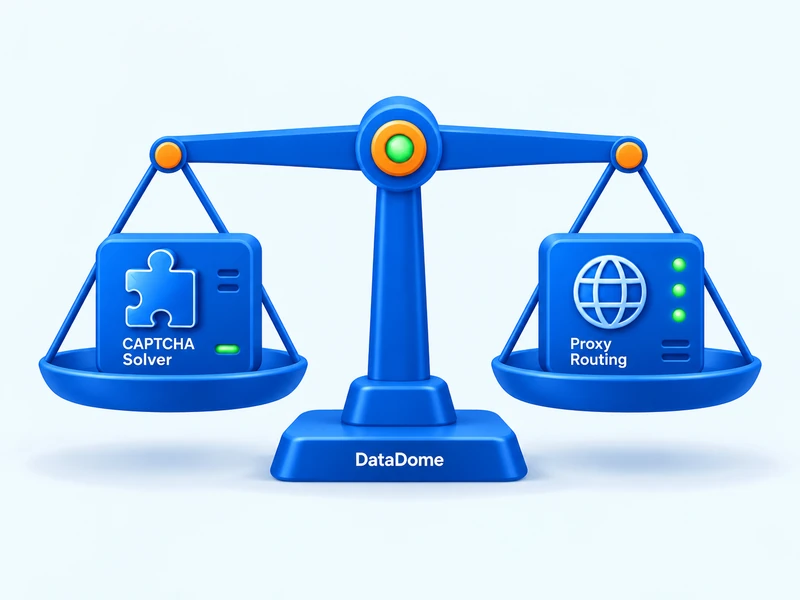
A decision matrix for an authorized target
| Observed situation | Investigate first | What not to assume |
|---|---|---|
| Expected content is returned, but the approved region is wrong | Routing and regional requirements | That a CAPTCHA API is needed |
| A visible verification challenge interrupts reading | Specific challenge compatibility | That a new IP completes it |
| The next request repeats verification | Context continuity | That the solver alone caused failure |
| A resource is explicitly denied | Permission and access policy | That another service grants access |
This matrix is a planning aid, not a diagnosis of every DataDome implementation. Inspect the response, and confirm the mode needed for the actual resource before selecting a service.
Choose a unit of work before a rotation strategy
A unit of work might be one independent product request, or an approved sequence from a listing to a detail page. Decide where continuity begins and ends. Rotation between independent jobs and continuity within one sequence serve different purposes; neither should be enabled blindly across every request.
Ask the proxy provider what a session identifier actually guarantees. Ask the API provider how that route is used in the confirmed mode. If each component has a different understanding of the session, a successful initial test may not survive the next step.
Compare cost per usable observation
Request price alone can be misleading. An unsuccessful request, a retry and a malformed response may consume resources without producing a record. A better planning measure is total permitted test cost divided by observations that pass your identity and field checks.
Use the same approved sample and validation rules when comparing setups. Record region, concurrency, session behavior and test time so the results can be interpreted. Do not treat one lucky page as a benchmark for an entire website, and do not invent a success-rate claim from a handful of trials.
Questions to answer before committing
- Is the exact target and challenge compatible?
- Which API or browser mode should the application use?
- Does the task require a consistent proxy and cookie context?
- How are failures and repeat requests billed?
- What diagnostic information is returned when the workflow cannot continue?
The Scrapingbypass DataDome product guide is a starting point for this discussion. Bring a target URL and a concrete read-only task rather than asking whether a whole domain can always be bypassed.
Choose the smallest setup that passes your acceptance test. Combine routing and challenge handling when the confirmed workflow needs both, keep application validation independent, and stop on explicit denial. This is a more defensible purchasing decision than adding services until an HTTP status changes.